Xiaomi Mi 8, the world’s first Smartphone with dual-frequency GNSS – compared to the usual L1 single-frequency devices.
The Mi 8 comes equipped with a Broadcom BCM47755 chip, being capable of a position accuracy within some decimeters. The Broadcom chip computes simultaneously the frequencies of two GNSS: GALILEO E1/E5a and GPS L1/L5. The additional use of the E5a/L5 frequencies reduces particularly the effect of multipathing (= reflection of satellite signals by buildings and cliffs), therefore ensuring a better accuracy.
Update: The latest Mi 9 and Mi 10 feature also L1/L5 & E1/E5a -Dualband-GPS!
NEW – Garmin Multi-Band & Multi-GNSS GPSMAP handhelds
Broadcom BCM47755 – GNSS frequencies
- BeiDou B1 (China)
- Galileo E1 (Europe)
- Galileo E5a
- GLONASS L1 (Russia)
- GPS L1 C/A (USA)
- GPS L5
- QZSS L1 (Japan)
- QZSS L5
(provided by: Broadcom)
Since I’m curious about the GPS accuracy of the Xiaomi Mi 8 I tested the Chinese smartphone in the Bavarian Alps while hiking. Especially tour 1 provided a challenging environment with a deep valley, cliffs and forest.
Xiaomi Mi 8 – Our Pragmatic Testing
- Xiaomi Mi 8 (version: MIUI 9.5.11.0 | Stable): Attached to the shoulder strap of our backpack for a perfect GPS reception. The track was recorded with the Android app Locus Map Pro (setting: every 10 m or 10 s).
- Garmin GPSMAP 64s: Placed in the upper pocket of the backpack with the GPS antenna upwards, ensuring a perfect GPS reception. Settings: GPS + GLONASS, track log every 10 m.
- Garmin Oregon 700: Placed at the shoulder strap of our backpack, ensuring a perfect GPS reception. Settings: GPS + GLONASS, automatic track log.
- Garmin fenix 5x: Wrist worn with a limited satellite reception (dynamically moving arm, shaded by the body, antenna not always facing to the sky). Setup: GPS + GALILEO, track log in intelligent mode.
Xiaomi Mi 8 – Results
Wow – the accuracy of the Mi 8 track log can be compared to our reference GPS device, the Garmin GPSMAP 64s and to the Garmin Oregon 700.
The GPSMAP 64s accuracy is a tad better, but you can see the differences only when you have some knowledge of the trail. The track of the fenix 5x from tour 1 shows – as expected – some strong shift, especially in the deep valley with cliffs and forest.
But I have some questions and remarks:
- How would a single frequency smartphone compare?
- Can the Locus Map Pro app compute the additional E5a/L5 signals?
- How does the antenna design of the Xiaomi Mi 8 affects the reception (multifunctional smartphone compared to specialized GPS devices); the antenna has a significant impact on the signal strength.
- Has the low amount of available E5a/L5 satellites an impact on the accuracy?
- GALILEO*: Maximum of three satellites with medium to high signal quality (a bad scenario especially for the fenix 5x), only two dual-frequency satellites (GALILEO will be fully operational in 2020)
- GPS: Maximum of two dual-frequency satellites with medium to high signal quality.
- However, I’mreally pleased by the Xiaomi Mi 8 GPS & GALILEO accuracy
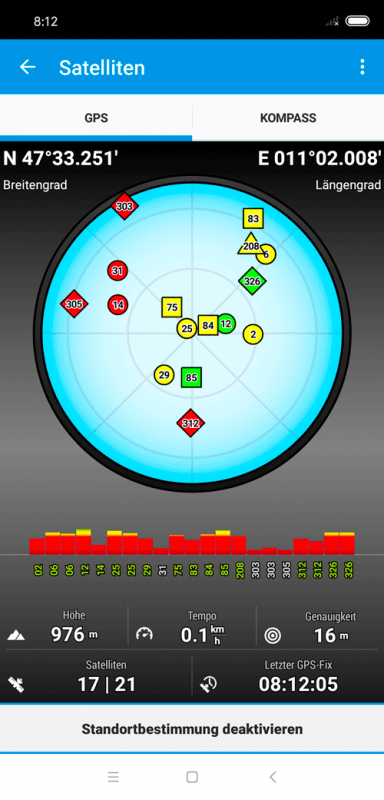
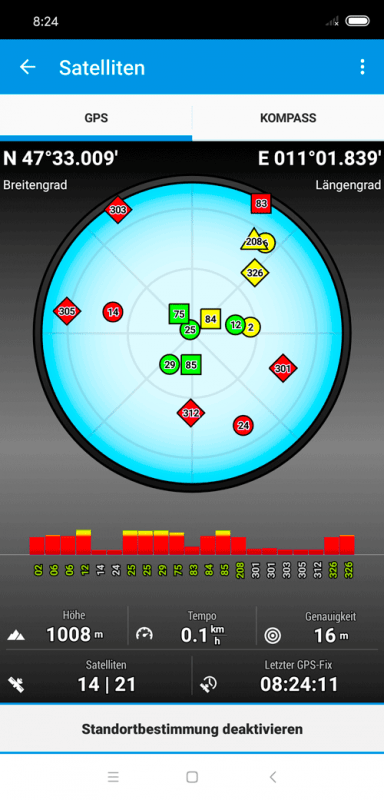
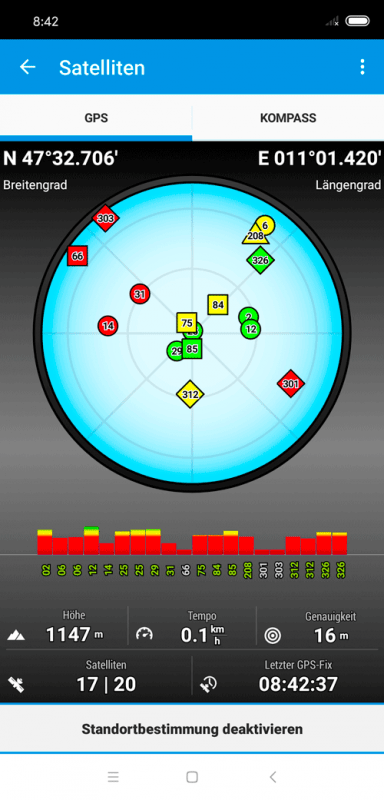
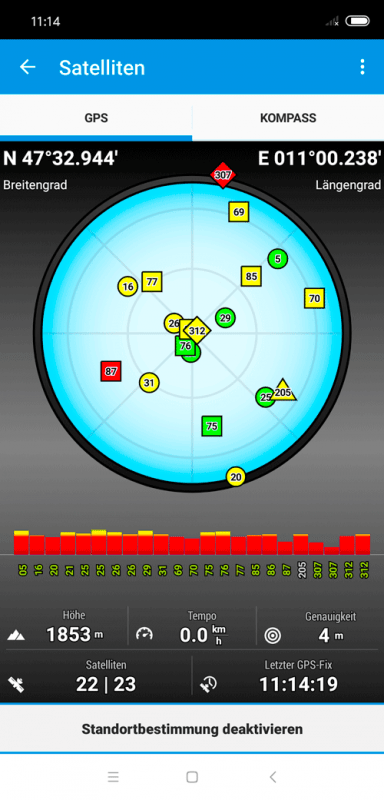
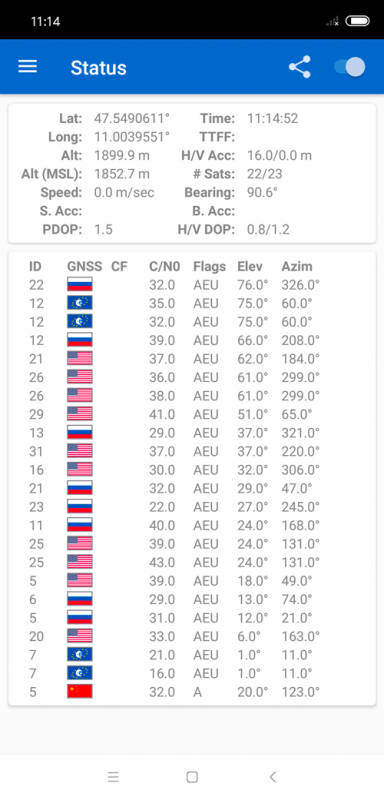
Screenshots: Locus Map Pro & GPSTest Android apps, screenshot locations see map.
- Circles: GPS (USA)
- Squares: GLONASS (Russia)
- Triangles: Beidou (China)
- Rhombus: Galileo (Europe)
- signal quality: red – low, yellow – middle, green – high)
- Height of bars: SNR (signal to noise ratio)
Satellites with two frequencies appear twice in the row with the satellite numbers. The accuracy of "16 m" might be a Mi 8 firmware error.
Update 15 Dec. 2018
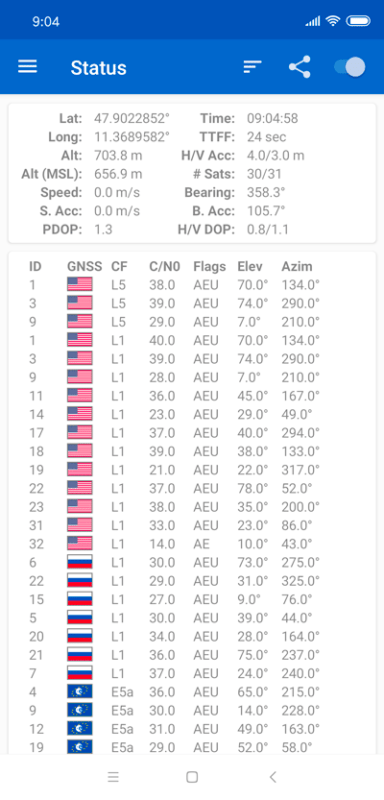
The latest update to Android 9 (China ROM MIUI Version 10.1.2.0 PEACNFI) brings CF values to the Xiaomi Mi 8. You can see it in the "GPSTest" App (GPS: L1/L5; GALILEO: E1/E5a).
Related links:
Comment
Comment
Hello,
I have Xiaomi MI9 receives all the satellites double frequencies visible with GPSTest. And that I see these satellites on Locus satellite page, the double frequencies are recognizable because there is twice the same number of satellite.
But Locus does not keep the satellites I can not record a trace with this smartphone, I also tried with Twonav Android, like it does not keep the satellites after a few minutes.
I do not see how to fix this in the smartphone settings.
Comment
Your test is worthless. You did not place the units above your head. That means the log is crummy. Your body is water. Your backpack has metal objects. Water and metal screw around with reception. I use a fiberglass rod to place the unit four feet above my head. I use rubber bands to secure the unit to top of the rod. Please go back and try it again to get honest results.
Why don’t you conduct this test yourself… Since you are clearly an expert and use fiberglass and rods (the same equipment that the rest of the world is using, on a daily basis). Good God.
Достоверность сравнение ми8 и гарминов относительно тропы на карте с неизвестной точностью самой карты и ее элементов дорог сомнительно. Как правило дороги и тропы являются записанными на тот же гармин треками пользователей с точность первые метры. Если заявленная точность определения местоположения ми 8 субметровая, то она выше точности карты с которой ее сравнивают? Я сравнивал самсунг 7 едж и гармин 62 на цифровом рельефе сделанном на заказ с точностью в плане 0,4м, на открытой местности при хорошем условии приема сигналов точность сопаставимая, на расчлененом залесенном рельефе с углами уклонов склона 20-30 градусов, выше точность у Гармин, видимо за счет более качественной антены. Ми 8 и гармин 64 сравнивал в помещении гармин не смог определить местоположение, ми 8 определил.
Hello
Where are the GPS chip and the GPS antenna, please?
Hi,
thanks for the review! Are you aware of any other phones coming out with dual-frequency? The chip used could be from Broadcomm or Qualcomm
thanks for your reply
J
Are you shure that the Xiaomi is working in dual frequency mode? Comparing it to a Garmin´s 64er is probably not the best way. The Garmin´s horizontal accuracy is about 3 meters and the Xiaomi´s should bei a few decimeters. Surveying < 1m is a whole other story. The Xiaomi Mi8 I use is definitely not as accurate as promised (testing 3-5 meters, like all other single frequenz gnss). Using the raw gnss log with Rinex files i got accuracy of almost 1 meter. But this was done in post processing. Hope for a Xiaomi update.
I am using the Xiaomi 8 and use the Geo++Rinex APP. I upload the file to the several on-line GNSS site for post processing. But I got an error message. "There is no L2 signal". Was I doing anything wrong !
I am a beginner for GPS raw dat. Would yo please give me some advice how to collect Rinex and where to do the post processing !
Thank you very much.
Hi, I can not help you at the moment because I never used post processing but may be i will learn it in the next future.
Cheers
Without dedicated software you will not be able to process phase GNSS data without L2. Try to process locally using for example RTKlib…
Please tell me: how do you get the RINEX file from Mi8?
Nice and very interesting test.
It would be indeed nice to add to the comparison another high-end mobile phone with single-band GPS and perhaps a test among tall buildings in city’s center.
Also I hope xiaomi will further improve and make firmware stable, it seems there are still bugs and problems going around.